
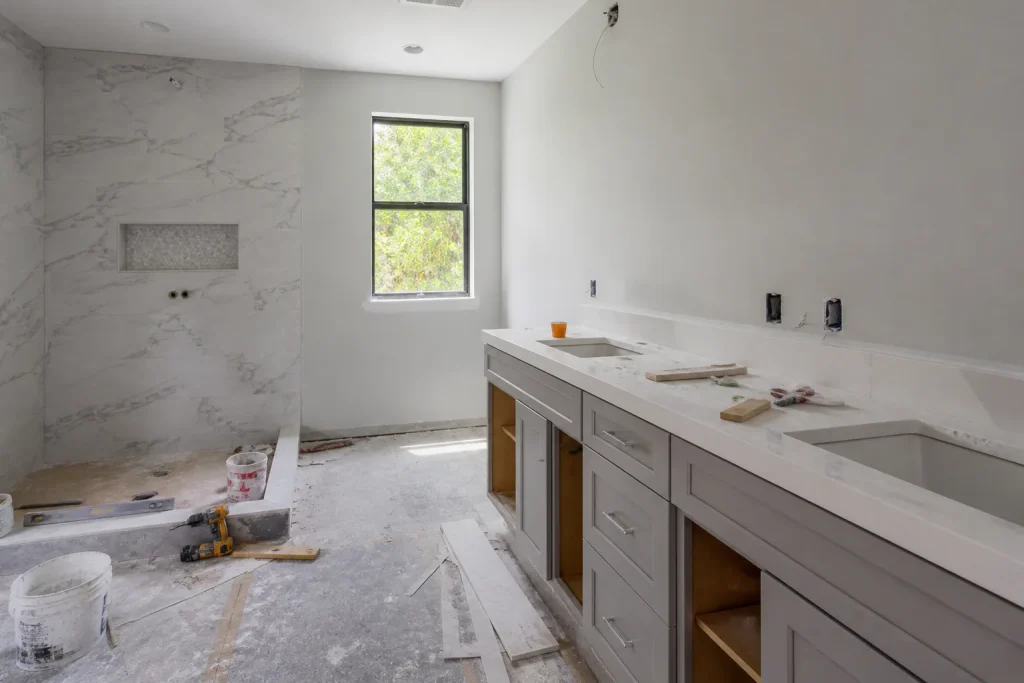

5 Mistakes to Avoid With Bathroom Remodeling
The average North Miami bathroom remodel runs about 18% over budget, and in almost every case the overage traces back to one thing: a scope agreed on before anyone pulled a tile sample to check the substrate underneath. The five mistakes below share that same root cause, decisions locked in before the hidden conditions were priced. Reorder the sequence so surprises come before the contract, not after, and the number on day one holds.
Here’s the short version if you’re skimming: check what’s behind the walls first, confirm your rough-in measurements before you buy anything, name your waterproofing product in writing, pull the Miami-Dade permit the work requires, and get a completion date with a remedies clause before the first cabinet comes out. If you’d rather not navigate that alone, call (888) 255-7411 and we’ll walk you through it.
1. Choosing Tile Before Anyone Checks the Subfloor

This is the mistake that quietly sets a North Miami bathroom remodel up for failure, because it happens at the tile showroom instead of the job site. The floor system underneath your bathroom – the joists, the subfloor sheathing, and the deflection between them – dictates which tile sizes and weights are even viable. A beautiful 24×48 porcelain slab needs a stiff, level floor. If your 1970s ranch in Keystone Point has a 1/2-inch particleboard subfloor over 2×8 joists on a wide span, that slab will crack at the first seasonal shift, and no grout or thin-set will save it.
What we do before a single tile is chosen:
- Measure floor deflection against the tile manufacturer’s minimum, not a guess.
- Check for soft spots, prior water damage, and any slope toward the drain.
- Identify whether the existing substrate is plywood, cement board, or something that has to come out entirely.
- Confirm the transition height to the hallway so the finished floor doesn’t sit above your door swing.
Only then does the tile list make sense. In our experience, the homeowners who start at the showroom spend the most on change orders, because the floor forces a redesign after the material is non-returnable. Start with the substrate. Choose tile second.
2. Ordering Fixtures Before the Rough-In Is Confirmed
A 1-inch drain offset can kill a $1,200 vanity choice, and it happens more than you’d think in North Miami’s older housing stock, where plumbing was roughed in to no consistent standard. The rough-in is the actual measurement of where your drain, supply lines, and vent sit relative to the wall. Order a vanity with a center-set drain and discover yours is offset to one side, and you’re either returning it, paying a plumber to move the drain, or living with a gap that never looks right.
The same trap catches toilets (a 10-inch vs. 12-inch rough-in changes everything), shower valves, and freestanding tub fillers. Before you buy:
- Measure the toilet rough-in as the distance from the finished wall to the drain center.
- Have the plumber confirm vanity drain location and supply height against the actual product spec sheet.
- Verify the shower valve depth fits the wall assembly you’re building, especially in a tile-over-cement-board wall.
- Hold off on ordering until the rough-in is confirmed by the person installing it, in writing.
We’ve seen a North Miami homeowner lose two weekends and a restocking fee on a vanity spec’d against a rough-in drawing that didn’t match the wall. Confirm the measurements first. Then order.
3. A Contract That Says “Waterproofed Shower” Without a Product or Method

“Waterproofed shower” means nothing in a written contract unless it names the product and the application method. It’s the single most common gap we find when a homeowner brings us a contract from another bidder. A rolled-on liquid membrane applied at three coats to a specific thickness and a sheet membrane bonded with the manufacturer’s seaming tape are both legitimate. A vague promise is not, and it’s what fails two years later as a soft spot behind the tile and a musty smell you can’t find.
What the contract should specify:
- The exact waterproofing product by name, and whether it’s liquid-applied or sheet.
- The substrate it sits on – cement board is a moisture-resistant backer, not a waterproofing layer on its own, and it must be treated as such.
- How seams, corners, and the shower pan-to-wall junction are detailed, since those are where water gets in.
- Whether a flood test is performed on the pan and for how long before tile goes down.
Name the product in the contract and you’ve made the promise testable. Leave it vague and you’ve made it a matter of opinion later. That’s a real E-E-A-T point, because a shower that leaks is rarely a tile problem. It’s an unspecified waterproofing problem.
4. Skipping the Miami-Dade Permit Where the Work Requires One
A bathroom remodel in North Miami triggers a permit more often than homeowners expect, and skipping it creates a resale inspection risk that can cost more than the permit itself. The rule of thumb: cosmetic work (paint, tile over an existing sound substrate, swapping a vanity in the same location) usually doesn’t require one. Work that touches the building’s systems or structure almost always does.
Permit triggers in North Miami typically include:
- Relocating or adding plumbing supply or drain lines.
- Moving or adding electrical circuits, outlets, or a new exhaust fan on a new run.
- Changing the shower pan size or relocating the shower.
- Removing or altering a wall, even a short one, if it’s load-bearing or contains mechanicals.
- New windows or a door change in the bathroom envelope.
Unpermitted work surfaces at resale, when the buyer’s inspector flags it and the closing stalls until it’s corrected and inspected. If your bathroom has a window that needs replacing as part of the project, that’s its own permit line, and a brand like ES Windows or Therma-Tru matters less than whether the opening was flashed and inspected correctly. Pull the permit, pass the inspection, keep the paperwork. It’s the cheapest insurance in the project.
5. No Written Completion Timeline With a Remedies Clause

“A few weeks” without a date in writing routinely becomes three months in North Miami, and the homeowner has nothing to point to when it does. A timeline isn’t a courtesy; it’s a commitment you can hold someone to. Without dates and a remedies clause, a slow job has no consequence and you have no leverage.
A real timeline includes:
- A start date and a substantial completion date, both in writing.
- The dependency chain: demo, rough-in inspection, waterproofing flood test, tile, cabinet install, final inspection. Each with a target date.
- What happens if a date slips – the remedies clause. A credit, a schedule reset, or a defined makeup plan spelled out in advance.
- Who owns material lead times, since a KraftMaid or Wellborn cabinet order has a real lead time that should be booked into the schedule, not discovered mid-job.
We’ve seen a North Miami job crawl from “three weeks” to eleven because the cabinet lead time was never in the timeline and the homeowner had no remedy written down. Put the dates and the consequence in the contract. A contractor confident in the schedule will sign it.
When to Call a Pro
Some of this you can check yourself. The rough-in measurement, the permit lookup, and reading your contract for a named waterproofing product are all things a careful homeowner can verify. But the moment water, electrical, or structure is in play, and it almost always is in a full bathroom remodel, this stops being a weekend project. Shower pans, plumbing relocations, and electrical circuits are where the expensive failures live, and they’re the wrong place to learn by doing.
Our technicians have up to 22 years of experience, are background-checked, and arrive in uniform, so you know exactly who is walking into your home. And every project carries the 365-Day Done Right Promise in writing: if the work fails inside that year, we come back and make it right at no charge, with a free return visit and no service call fee. That’s The Kingswell Way – say the price before the work, show up in the window we gave, leave the place cleaner than we found it.
Related services in North Miami
If the bathroom is one part of a larger project, the same decision sequence applies to our Kitchen Remodeling in North Miami work and to any Bathroom Remodeling in North Miami we take on. For the full scope of what we build, see our General Contractor in North Miami page, or start at the Penhallow Remodeling North Miami home page.
The Bottom Line
The five mistakes that cost North Miami homeowners the most all come down to commitments made before the hidden conditions were priced. Check the subfloor before the tile, confirm the rough-in before the fixtures, name the waterproofing product in the contract, pull the permit the work requires, and get a completion date with a remedies clause in writing. Get those five right and the 18% overage largely disappears, because the surprises land before the contract instead of after demo day.
Do those five things and you’ve already avoided the mistakes most North Miami remodels make. Every Penhallow Remodeling North Miami project gets a written price before any work starts, so the number on day one is the number on the invoice, backed by the 365-Day Done Right Promise. If you’re in North Miami and need help, Penhallow Remodeling North Miami offers free estimates: call (888) 255-7411. A live person answers any time, not voicemail.
Frequently Asked Questions
A typical full bathroom remodel in North Miami runs $15,000-$35,000 for a standard hall or guest bath, and $30,000-$60,000 or more for a primary bath with a walk-in shower, freestanding tub, and upgraded cabinetry. The biggest cost drivers are whether plumbing and electrical move, the tile and waterproofing system you choose, and the cabinet and countertop line. Cosmetic-only updates (tile, fixtures, paint without moving anything) often land in the $8,000-$15,000 range. Call (888) 255-7411 for an exact written quote – estimates are free.
Yes, if the work touches plumbing, electrical, structural walls, the shower pan, or the building envelope. Cosmetic-only work generally does not require a permit. When in doubt, pull the permit: unpermitted work surfaces at resale and can stall a closing until it’s corrected and inspected. Call (888) 255-7411 and we’ll tell you exactly which permits your North Miami project needs.
It shouldn’t, and on our projects it doesn’t. Every Penhallow Remodeling North Miami job gets a written price before any work starts, so the number on day one is the number on the invoice. The overages homeowners fear usually come from a scope agreed on before the hidden conditions (subfloor, rough-in, waterproofing) were checked. We price those in first. Call (888) 255-7411 for a written quote you can hold us to.
A full bathroom remodel typically takes 3-6 weeks from demo to final inspection, depending on material lead times and inspection scheduling. Cabinet orders from a line like KraftMaid or Wellborn carry a real lead time that should be booked into the schedule up front, not discovered mid-job. Get the completion date and a remedies clause in writing. Call (888) 255-7411 to schedule your free estimate and see a real timeline for your North Miami bathroom.
A moisture barrier resists vapor and splash; waterproofing keeps liquid water out entirely, which is what a shower needs. Cement board behind tile is moisture-resistant backer, not waterproofing on its own. A real waterproofed shower names a specific liquid or sheet membrane product and its application method in the contract. Call (888) 255-7411 and we’ll explain exactly what we install and why.
Written by the team at Penhallow Remodeling North Miami.
Need Construction Help?
Call Penhallow Remodeling North Miami - licensed & insured, here with fast after-hours help in North Miami.
(888) 255-7411