
Techo-Bloc General Contractor in North Miami: A Homeowner’s Guide
Techo-Bloc slabs can run twice the per-unit cost of standard pavers. But if your contractor specs the same base and drainage plan they’d use for a budget stone, you’re paying premium prices for a mid-grade result. The product is only half the job. The other half is the base aggregate depth, the edge restraint, and the drainage plan underneath it – and that’s where most North Miami installations quietly fail.
Key Takeaways
- Techo-Bloc’s density and load rating are worth the premium in North Miami; its freeze-thaw resistance is not the reason – we don’t have freeze-thaw cycles.
- Driveways, patios, and pool decks need different Techo-Bloc product lines, thicknesses, and base depths. One product for all three is a red flag.
- A written quote should itemize product line and thickness, base aggregate depth, edge restraint type, polymeric sand, and sealer.
- North Miami’s flat grade and heavy summer rain mean drainage is designed, not assumed.
- Minor joint sand settling in the first 90 days is normal. Loose pavers, rocking slabs, or water pooling is not.
How Does Techo-Bloc Differ From Tremron and Standard Concrete Pavers in South Florida?
The short answer: Techo-Bloc’s real advantage in South Florida is density and load tolerance, not freeze-thaw resistance. Techo-Bloc markets its pavers heavily around northern winters. Its products are pressed at high density with tight dimensional tolerances, and many lines carry compressive strengths well above what a standard concrete paver offers. That density matters here – just not for the reason the brochures emphasize.
Here’s what actually counts in North Miami:
- Load rating. A driveway in North Miami takes delivery trucks, boats on trailers, and the occasional contractor’s F-250. Higher-density pavers resist point loads and edge spalling better than standard 60mm concrete units. For driveways, you want a paver rated for vehicular traffic – typically 60mm minimum, often 80mm for heavier use.
- Fade resistance. South Florida’s UV index is unforgiving. Techo-Bloc’s pigment is integrated through the paver body rather than surface-applied, which slows the chalky fade that cheaper pavers show after a few summers in direct sun.
- Dimensional consistency. Tighter tolerances mean narrower joints, less sand migration, and a cleaner finished surface. That matters more in Florida than the freeze-thaw claims, because our failure mode is water and sun, not ice.
- Tremron comparison. Tremron is a solid Florida-made product and a legitimate choice for many budgets. Tremron pavers are generally lighter and less expensive. Techo-Bloc’s edge is density and finish quality – the surface textures and color blends hold up better under heavy foot traffic and pool-deck splash.
If a contractor’s sales pitch leans entirely on “freeze-thaw rated,” they’re reading you a brochure written for Minnesota. Ask instead about density, load rating, and what base depth they’re planning for your specific application.
Why Do Driveways, Patios, and Pool Decks Need Different Techo-Bloc Products in North Miami?

Because they take different loads and sit in different water. A driveway carries vehicles; a patio carries furniture and feet; a pool deck sits in constant splash and chemical exposure. A contractor who specs the same Techo-Bloc product for all three is either working from a template or doesn’t understand the difference. Both should worry you.
Here’s how the three applications break down:
- Driveway. Needs a load-rated paver, usually 60mm to 80mm, over a deeper compacted base – commonly 6 to 8 inches of aggregate depending on soil and load. Edge restraint has to be robust and pinned, because driveway edges take the most lateral pressure. Techo-Bloc’s denser lines like Borealis or Blu are common picks here.
- Patio. Lower load, but the finish and comfort matter more. Thinner profiles, larger formats, and textured surfaces for bare feet. Base depth can be shallower – typically 4 to 6 inches of compacted aggregate – because it’s not carrying vehicles.
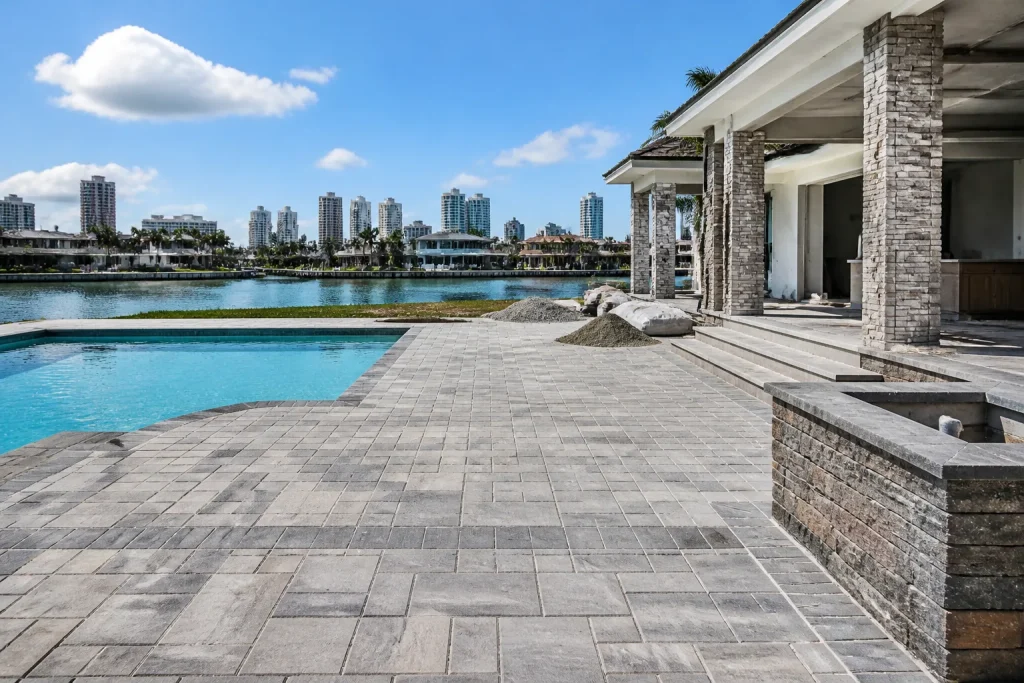
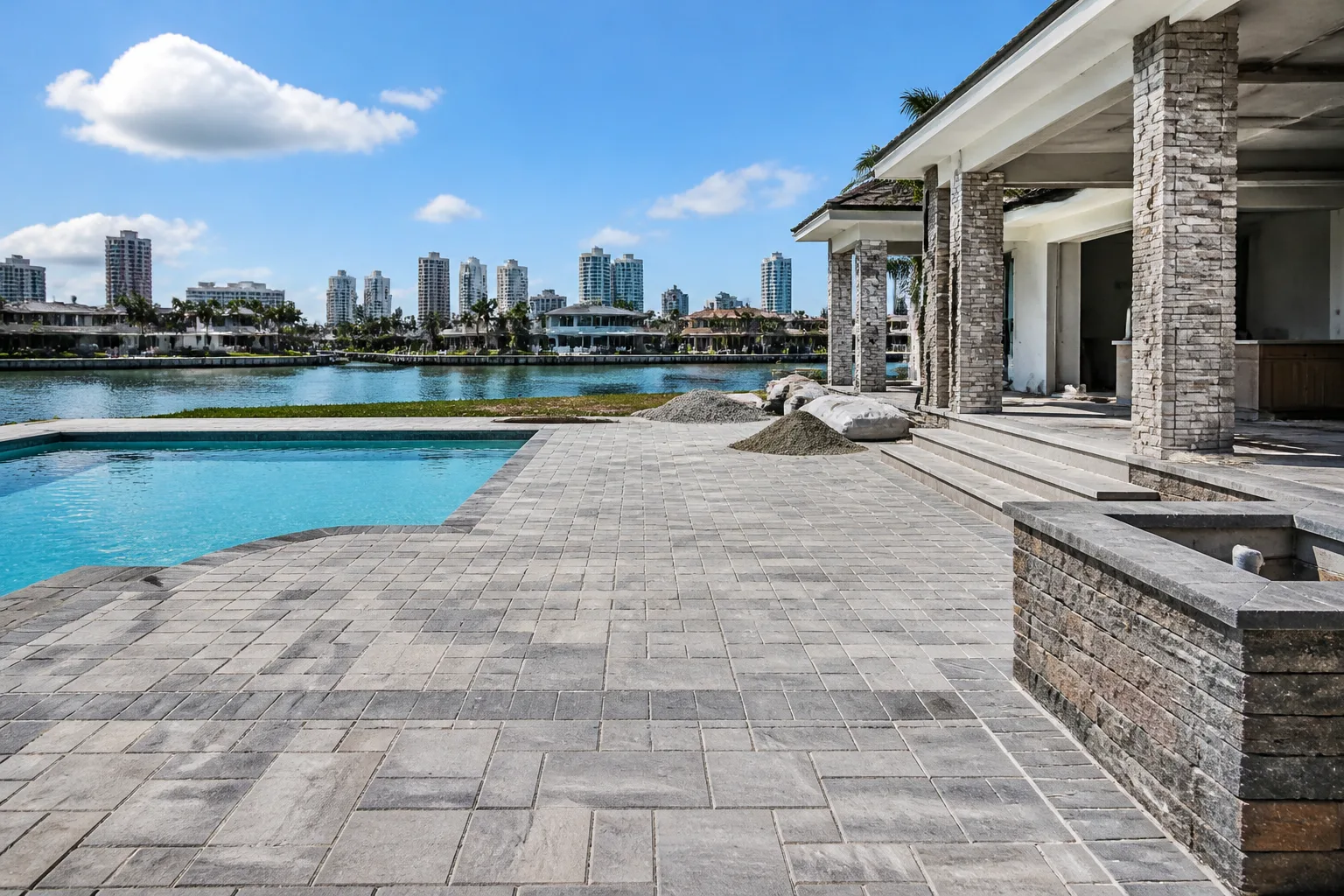
- Pool deck. The hardest one to get right in North Miami. The product needs a slip-resistant texture, must handle constant chlorine and salt splash, and has to drain fast. Pool decks often need a different edge detail and a sealer that won’t turn slick. Techo-Bloc’s textured lines handle this well; polished or very smooth finishes don’t.
When you get a quote, ask which product line and thickness they’ve specified for each area of your project. If the answer is the same product for the driveway and the pool deck, get a second opinion. That’s not a detail – it’s the whole job.
Related services in North Miami: our General Contractor in North Miami page covers the full scope of hardscape and exterior work we handle.
What Should a Written Techo-Bloc Quote Itemize?
A written quote for Techo-Bloc installation should itemize five things: the product line and thickness, the base aggregate depth, the edge restraint type, the polymeric sand, and whether sealer is included. If any of those is missing, you’re not looking at a real quote – you’re looking at a ballpark that will change once the crew shows up.
Here’s the checklist we hand every homeowner:
- Product line and thickness. Not just “Techo-Bloc.” The specific line and the millimeter thickness for each area. This is where the price lives.
- Base aggregate depth. The number of inches of compacted crushed stone under the pavers, and whether geotextile fabric is included. In North Miami’s sandy soil, fabric is not optional.
- Edge restraint type. Plastic edge, aluminum edge, or poured concrete curb. Each holds up differently, and the wrong one fails first.
- Polymeric sand. Brand and whether the joints are sanded correctly. Cheap sand washes out in the first heavy rain.
- Sealer. Included or not, and which product. Sealer affects slip resistance on pool decks, so it’s not a cosmetic upgrade.
Ask for the written price before any work starts. We put the number in writing so the number on day one is the number on the invoice – no change order surprises after demo day. If a contractor won’t put the itemized number on paper, that’s your answer right there.
How Does Drainage Work on a Techo-Bloc Job in North Miami?

Drainage on a Techo-Bloc job in North Miami has to be designed, not assumed. North Miami sits on flat ground with a high water table, and the region gets hammered by heavy summer rain events. There’s no natural slope to carry water away, so a patio or driveway that drains “by gravity” in most cities has nowhere to go here.
What a proper drainage plan looks like on a North Miami install:
- Engineered slope. Every Techo-Bloc surface needs a minimum slope – usually 1 to 2 percent – pitched toward a defined outlet, not the house foundation or the neighbor’s lot.
- A defined outlet. That might be a French drain, a dry well, or a tie-in to the storm system, depending on the property. On a flat North Miami lot, water that leaves the surface has to go somewhere specific.
- Base compaction. Undercut or under-compacted base is the number-one cause of pavers settling into a low spot that pools. Deck the base to the right depth and compact in lifts.
- Permeable options. For some properties, a permeable Techo-Bloc system (open joints, open-graded base) is worth discussing. It’s not the right call for every driveway, but on lots that already flood, it changes the equation.
We pulled a pool deck project in North Miami last season where the previous install sloped toward the pool, which sounds fine until you realize the coping trapped the water and the deck flooded after every rain. The pavers were gorgeous. The drainage plan wasn’t there. Techo-Bloc is the same way – the product is only as good as the water management underneath it. That’s the conversation to have before the first stone goes down.
What Should You Expect in the First 90 Days After a Techo-Bloc Install?
In the first 90 days, minor joint sand settling and slight surface movement are normal. Loose or rocking pavers, water pooling, and sand washing out are not. Knowing the difference is how you protect yourself and how you know whether to call back the installer or just wait it out.
The normal stuff:
- Joint sand settling a quarter-inch or so in high-traffic areas. Plan on topping it off once in the first season. That’s maintenance, not failure.
- A few pavers with a faintly visible joint line where the base compaction has fully readied itself. Cosmetic, not structural.
- Color settling slightly as the surface oil and manufacturing residue weathers off. Usually two to four weeks.
- Efflorescence – a white powdery film that shows up on some pavers after installation. It’s naturally occurring, weathers off over a few months, and can be cleaned. It’s not a defect.
The call-back stuff: pavers that rock or move underfoot, joints that wash out in the first heavy rain, water pooling anywhere on the surface, or slabs that sit noticeably uneven. Any of those means the base, edge restraint, or drainage plan wasn’t right. That’s a written guarantee issue, not a maintenance task.
Under the 365-Day Done Right Promise, if something in that call-back list shows up, we come back and make it right at no charge – and if a repair fails inside the guarantee period, the return visit is free with no re-inspection fee. Put that in writing before the first paver’s laid, and the first 90 days become a lot less stressful.
When Should You Call a Pro Instead of DIY?

Call a pro the moment the job involves a base deeper than a few inches, an edge restraint, or drainage planning. Techo-Bloc installation isn’t a weekend DIY project for most homeowners – not because the pavers are hard to lay, but because the base, compaction, and drainage are where the money and the failure live. A well-compacted base done in proper lifts, with geotextile fabric and a real slope plan, is genuinely hard to do correctly with rented equipment and a few friends on a Saturday.
We’ve seen enough do-it-yourself Techo-Bloc patios sink into North Miami sand to say it plainly: the pavers are the easy part. The 6 to 8 inches of compacted base underneath is the job. Our technicians have up to 22 years of experience with base prep, drainage, and edge restraint, and we put the specifications in writing before we start.
The Bottom Line
Techo-Bloc’s real value in North Miami is density, load tolerance, and finish quality – not the freeze-thaw claims written for northern snowbelt cities. The product is worth the premium, but only if your contractor specs the right line for each application and builds the base and drainage to match. Ask for the itemized written quote, ask what’s under the surface, and put the guarantee in writing before the first paver goes down.
If you’re in North Miami and want help sorting out the right Techo-Bloc system for your driveway, patio, or pool deck, Penhallow Remodeling North Miami offers free estimates. Call (888) 255-7411 – a live person answers 24/7. Or explore our Penhallow Remodeling North Miami home page and Bathroom Remodeling in North Miami for the rest of what we do around the house.
Frequently Asked Questions
Techo-Bloc installation in North Miami typically runs $18 to $35 per square foot installed, depending on the product line, thickness, base depth, and finish. A standard driveway with an 80mm load-rated paver over an 8-inch base will land at the higher end. A simple patio with a 60mm paver over a 4-inch base will come in lower. Pool decks add cost for slip-resistant textures and sealer. Call (888) 255-7411 for an exact written quote – estimates are free.
It is if you care about density, fade resistance, and longevity under heavy traffic, and your contractor builds the base to match. It isn’t if they’re going to spec the same base and drainage plan they’d use for a budget stone – you’d be paying premium prices for a mid-grade result. Ask about the base depth and edge restraint before you compare per-unit costs.
A typical driveway in North Miami takes 3 to 5 working days for a crew of three to four, depending on square footage, base depth, and how much excavation is needed. Patios run 2 to 4 days. Pool decks can go longer because of the finish and sealer process. Rain days in the summer extend the schedule. We build a real arrival window into the written quote before we start.
Patios usually don’t require a permit. Driveway work, and any install that changes drainage or connects to the storm system, often does – North Miami and Miami-Dade County have specific requirements around impervious surface and drainage. Our quotes identify what’s needed for your property, and the permit gets pulled and the inspection passed before the job closes. If a contractor tells you no permit is ever needed for a driveway, ask them to put that in writing.
Written by the team at Penhallow Remodeling North Miami.
Need Construction Help?
Call Penhallow Remodeling North Miami - licensed & insured, here with fast after-hours help in North Miami.
(888) 255-7411